

|
|

Part One : Page 2 of 2
Guy Wire Tourniquet
A tourniquet can be created by creating a doubled-up length of copper wire (instead of a single strand of wire with normal guy wires), looped around the bent branch and it's anchoring point.
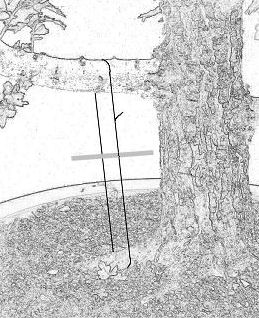
A guy wire looped over the bent branch and it's anchoring point ready to be twisted. (Note: For clarity, cushioning is not shown in the image, however, always provide protection for the bark from the wire)
As the name suggests, a metal bar is inserted in between the two lengths of wire which are then twisted together.
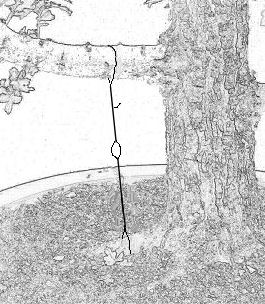
The advantage of using a guy wire tourniquet is that as the two lengths of wire are twisted together, they shorten and will pull the branches together with a great deal of strength. This is especially useful for moving very stubborn branches a few degrees further than might be possible by hand. Additionally, for brittle branches or branches where there is a risk of splitting or snapping, the tourniquet can be tightened slowly over a period of weeks, reducing the risk of damage.
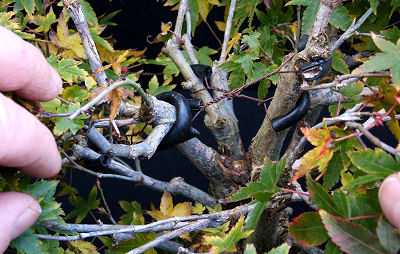
The central leader of this Acer palmatum 'Kiyohime' has died back. To fill the gap in the foliage crown, it has been necessary to move some very thick and very brittle surrounding branches. This has been carried out over the course of a growing season with the use of several tourniquets that have been twisted at regular intervals.
Turnbuckles
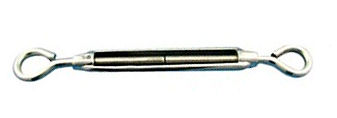
Turnbuckles work by the same principle as tourniquets. However, rather than pulling the branch and anchor point closer together by twisting the guy wires, a turnbuckle is used to pull two guy wires together by tightening the buckle itself.
Turnbuckles are advantageous as (if long enough) they can move a branch further than the limited distance afforded by a tourniquet, however, they are more obtrusive and unpractical to use in tight spaces.
Branch Clamps (sometimes referred to as branch benders)
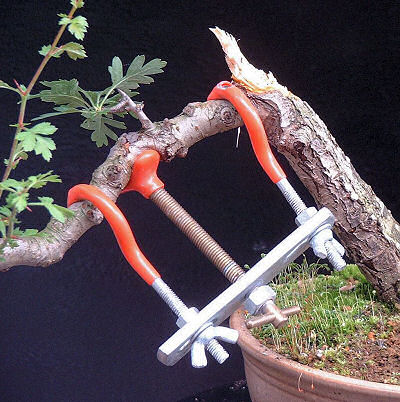
Branch Clamp
These
things are still found for sale from various bonsai outlets
and should be regarded as just a strange form of medieval torture
that has little or no use in bonsai.
With the two outside legs ‘gripping’ the branch,
the middle leg slowly lengthens (by being turned on a screw-thread)
bending the branch. These contraptions do produce a
tight bend in the branch but I found that however much care
was taken (including the use of padding around the ‘feet’)
the bark of the branch was always damaged.
I have found that anything that can be achieved with Branch
Clamps can also be achieved using coiled wire, guy wires and
a little strength or the help of a friend. For these reasons,
I avoid using branch clamps!
Branch benders
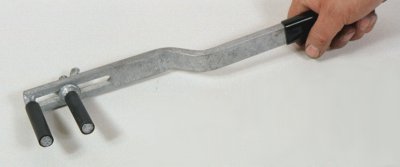
Branch Bender
A
branch bender is a metal lever with two prongs that ‘grip’
the branch allowing the user to exert a far greater load on
a branch, causing it to bend into position (where it can then
be guy wired).
As with branch clamps, there is a need to protect the bark from
being damaged when using a branch bender, it is also possible
for the bark to be physically ripped and separated from the
wood if care is not taken.
Bending a branch by weakening its structure
The techniques already described in this article increase the possibility of bending thick branches, however, when a branch is so thick or brittle that it can still not be manipulated into position, it’s structure must first be weakened to make bending easier.
<<Bending ‘Thick’ or Brittle Bonsai Branches Part One: Page 1 of 2
>>Part Two of this article addresses Notching